School Bus Simulator Driving
- 4.3
- Rating
- 10.00M
- Installs
- Free
- Price
 Analysis by App-foxy
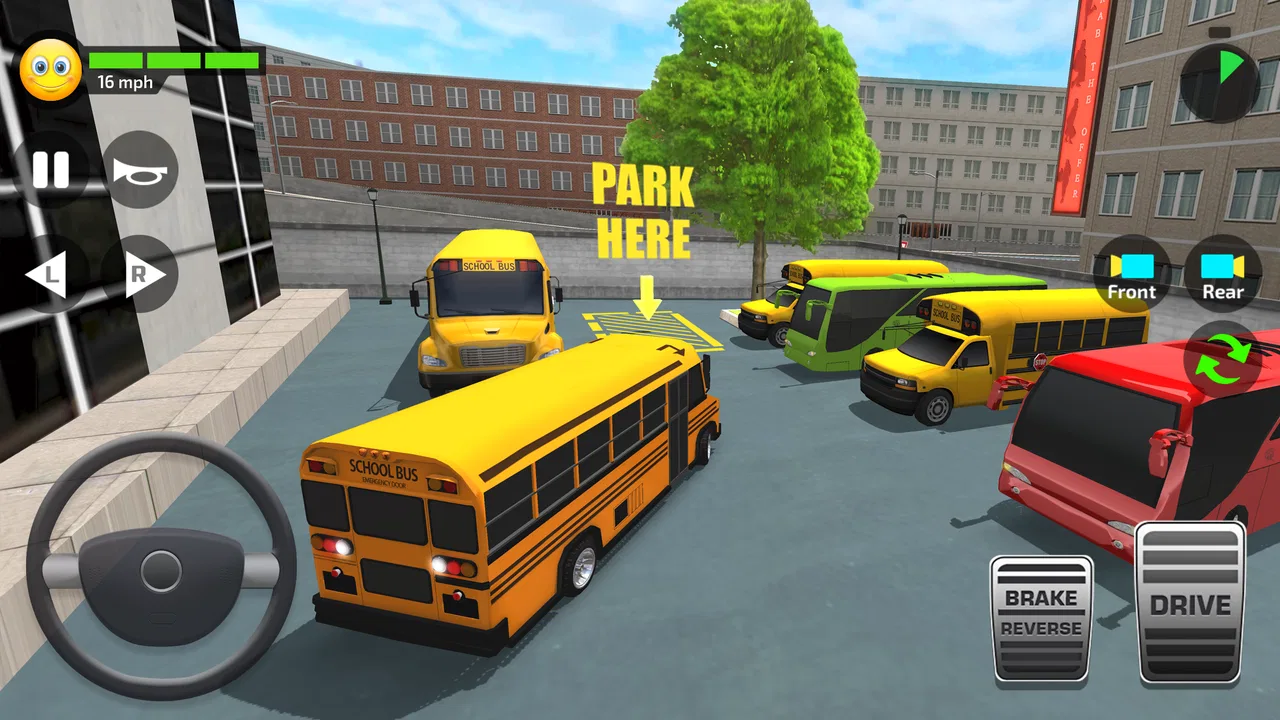
I spent time with School Bus Simulator Driving as a casual racing game built around a very different idea of driving: the goal is not to beat traffic or leave rivals behind, but to handle a school bus carefully enough to reach the right places and park properly. That change of pace gives it a more deliberate feel than a typical racing title, and it makes every turn, stop, and correction matter more than raw speed.
Developed by Games2win.com, the game is free to download and aimed at Everyone. It has been available since August 23, 2016, and its current version is 8.0. With an average rating of 4.3 from around 80 thousand ratings and over 10 million installs, it has clearly found a large audience among players who enjoy straightforward driving challenges rather than complicated simulation menus.
My first impression was that this is best understood as a school bus driving and parking game with racing-category appeal, not as a conventional competitive racer. You are learning to manage a large vehicle, keep control through turns, and complete routes without treating the road like a track. That makes it approachable, but it also means anyone expecting high-speed races, licensed cars, or deep vehicle tuning may feel that the game is intentionally narrow.
You May Also Like

 Blood Strike: 2.5 Anniversary
Blood Strike’s Loadouts Turn Every Drop Into a Tactical Gamble
A close look at Blood Strike’s custom loadouts: how fast access to signature weapons reshapes its battle royale rhythm, rewards preparation, and narrows the gap between fights.

 Pandora - Music & Podcasts
Pandora’s Music Is Easy to Start, but Harder to Recover
Pandora’s strength is its low-effort path from a seed to a station. Its weak spot is how much confidence it asks you to place in connection, setup, and quiet recovery.

 8 Ball Pool
 Is Built on Rivalries, Rematches, and Routine
A close look at the rivalries, rematches, shared routines, and unanswered safety questions that turn a quick pool match into a persistent mobile community.

 Samsung Music
’s Quiet Strength Is Playing What You Already Own
Its reach comes less from spectacle than from dependable access to a personal library. That simplicity is both the app’s strongest retention engine and its ceiling.

 AccuWeather: Weather Radar
AccuWeather Review: A Quick, Clear Forecast for Everyday Decisions
For everyday plans, the best forecast is the one you can understand quickly. AccuWeather makes rain timing, radar, and local conditions easy to act on, with a few trade-offs.

 Hill Climb Racing
Why Hill Climb Racing Still Turns Crashes Into One More Run
A tiny car, a bumpy hill and one more upgrade: Hill Climb Racing keeps resurfacing because its simple chaos makes every near-miss feel personal.
More From Our News Desk



How the driving feels during quick and demanding sessions
I find the bus’s weight most apparent when I try to rush a turn or correct my approach at the last moment. In a quick session, slowing down before the maneuver usually gives me more useful feedback than pressing harder and hoping to recover. That makes each attempt feel like a small lesson in timing, and it sets up why a clean finish can be satisfying even without a rival to beat.
Speed expectations: controlled movement instead of constant acceleration
The most important thing to understand before installing it is the pace. The fun comes from controlling a school bus, not from reaching extreme speeds. A bus naturally feels less nimble than a small car, so the game asks me to think ahead. I have to begin a turn early, leave enough room for the vehicle to swing around, and avoid treating every open stretch as an invitation to accelerate without care.
That slower rhythm is useful for short sessions. I can open the game when I want something more active than a puzzle but less demanding than a competitive racer. A quick attempt gives me a clear objective: drive, position the bus, and finish the task. There is little need to learn a large collection of systems before getting started, which is one reason the game works well for younger players and casual users.
At the same time, the deliberate speed can feel repetitive if I prefer constant action. Traditional racing games usually reward late braking, rapid overtakes, and aggressive cornering. Here, those habits are more likely to create mistakes. The satisfaction comes from making a clean approach and keeping the bus under control, so the game rewards patience more than reflexes.
I found that the best way to judge progress is not by asking whether the bus feels fast, but whether my route planning improves. A turn that seemed awkward at first becomes easier once I slow down before entering it. That creates a small but genuine learning curve: I am not simply memorizing acceleration, I am learning how the size and movement of the vehicle affect every decision.
Heavy-use moments: where careful control matters most
The busiest moments are not necessarily the fastest ones. They happen when I need to combine several actions at once: approach a stopping point, line up the bus, make a turn, and leave enough space to correct the position. Parking is particularly revealing because a small error in angle can force a second attempt. The game’s central challenge becomes clearer there than during a simple straight drive.
One useful everyday scenario is playing during a short break while waiting for an appointment. I can complete a focused driving attempt without needing to remember a long story or manage a complicated inventory. If the session ends suddenly, the experience is easy to put down. On the other hand, when I have more time, repeating a difficult route gives me a reason to keep playing because I can test whether a slower approach produces a cleaner result.
My practical tip is to treat the bus as a vehicle that needs space, not as a small car with a different appearance. I try to reduce speed before the turn rather than during it, and I avoid making several sharp corrections in a row. When parking, I prefer a calm, wider approach over trying to squeeze into position in one dramatic movement. This is one of the game’s less obvious lessons, and it makes the controls feel more predictable.
Another trade-off appears when a player wants to improve quickly. Repeating the same type of maneuver can build confidence, but it can also expose how limited the experience feels if the player wants a broad variety of racing situations. The game is strongest when I enjoy practicing control. It is weaker when I need changing opponents, a large range of vehicles, or the excitement of a full race weekend.
Reliability: a simple structure helps, but expectations should stay realistic
Because the game focuses on one clear theme, it is easy to understand what I am doing when I return to it. I do not need to relearn a complex set of menus each time. That simplicity supports reliable casual use: launch it, choose the driving activity available to me, and concentrate on the bus. The large install base and current version 8.0 also suggest that the title has remained relevant to a substantial group of players.
Still, long-term enjoyment depends heavily on whether I like the core loop. A simple driving game can feel dependable without feeling endlessly fresh. If I enjoy gradual improvement, parking accuracy, and vehicle handling, that focus is a strength. If I need frequent novelty, the same focus may become a limitation after several sessions.
There is also a financial point worth considering. The game is free, but optional in-app purchases range from $0.99 to $49.99 per item. I would therefore approach it as a free starting point and decide carefully before paying for anything. A player who only wants a few casual drives may have no reason to spend money, while someone who becomes deeply invested should still consider whether the purchase adds enough value to justify the cost.
The Everyone content rating makes it suitable for a broad audience, but suitability does not mean every child will enjoy it. Younger players who like buses, driving, and clear objectives may find the theme appealing. Children looking for rapid competition, flashy stunts, or constant rewards may lose interest sooner. For parents, the sensible approach is to treat the game as a driving activity and remain aware that optional purchases exist.
Device constraints: what to consider before a long session
The minimum operating-system requirement is Android 7.0, so the game is not intended for every very old Android device. That is useful to check before downloading, especially if the phone has been kept for many years. The requirement itself does not tell me how the game will behave on every model, but it does establish a basic compatibility boundary.
In practical use, I would also think about the condition of the phone rather than focusing only on the operating-system version. A device with limited free storage, many background apps, or a battery already under strain may provide a less comfortable session than a newer, cleaner device. Driving games keep the screen active and require continuous touch input, so heat and battery use can become more noticeable during extended play even when the game is not technically demanding.
This is where the title differs from a visually ambitious racing game. Its bus-driving concept does not require me to approach it as a showcase for the latest phone. I would choose it for accessible play and a clear objective, not because I want to test graphics hardware. Players with older compatible devices should keep their expectations sensible, while players with modern phones should not assume that extra power will transform the basic gameplay into a deeper simulator.
For a smoother routine, I would close unnecessary apps before a long session, keep the display at a comfortable brightness, and avoid judging performance immediately after the phone has been heavily used for another demanding task. Those are general habits, but they matter here because the game’s appeal depends on precise control. A brief input delay or an uncomfortable warm device can make a careful parking challenge feel more frustrating than it really is.
Recovery after mistakes: learning is part of the appeal
Mistakes are not just failures in this game; they are information about how I handled the bus. If I approach a corner too quickly, clip the route, or end up poorly aligned, the next attempt gives me a clear adjustment to make. I can brake sooner, widen the turn, or change the angle before parking. That makes the game more forgiving psychologically than a racer where one mistake immediately destroys a competitive run.
A useful recovery method is to change one decision at a time. If I alter speed, steering, and stopping position all at once, I do not know what solved the problem. Instead, I slow down earlier and watch whether the bus settles into the turn. If that works, I keep the change and then refine the final alignment. This approach turns repetition into practice rather than random retrying.
The limitation is that recovery can become tedious when I make the same mistake repeatedly. Players who enjoy experimentation will probably appreciate the chance to refine their technique. Players who want instant resets followed by a completely different challenge may see the repeated bus handling as a chore. The game’s strongest audience is therefore patient enough to learn from small corrections.
Who will enjoy it, and who should choose another racer?
I would recommend it to someone who likes vehicle-control games, parking challenges, and uncomplicated objectives. It is also a reasonable choice for a child or casual player who wants to practice the idea of driving a large vehicle without being dropped into a complicated management simulation. The free entry point makes it easy to try before deciding whether the bus-focused gameplay matches personal taste.
I would not choose it for someone searching for realistic traffic systems, competitive multiplayer, extensive vehicle collections, or a deep career mode. Those players will probably be happier with a broader racing game or a more serious driving simulator. A conventional racer is better when the main goal is speed and competition; a detailed simulator is better when the goal is technical realism and a wide range of settings.
The comparison is not entirely one-sided, though. Many racing games are exciting but exhausting because they demand constant attention and often push the player toward aggressive decisions. This one offers a calmer alternative. I can focus on positioning and control without needing to beat another driver. That makes it a better fit for relaxed practice, while the usual racing alternatives remain stronger for adrenaline and variety.
My performance verdict after using it
School Bus Simulator Driving works because it commits to a specific fantasy: handling a school bus carefully and learning how to park it. The perceived speed is intentionally moderate, the heavy-use moments are built around turns and alignment, and the simple structure makes it approachable for short sessions. I also appreciate that the game gives mistakes a practical purpose; every failed approach can teach me something about timing and space.
Its weaknesses come from that same focus. The experience may feel narrow for players who need a steady stream of new race types, opponents, or vehicles. Optional purchases also deserve attention because the game is free to start but includes items priced from $0.99 to $49.99. I would play first without spending, then decide whether the extra value is genuinely useful rather than treating purchases as part of the basic requirement.
Overall, I see it as a friendly, focused driving game rather than a replacement for a full racing simulator. Games2win.com has shaped the experience around a bus, parking, and controlled movement, and that gives it a clear identity. With a 4.3 average and more than 10 million installs, it is easy to see why it appeals to a broad casual audience. If you want a patient driving challenge that rewards better positioning more than raw speed, this is worth trying; if you want nonstop racing action, choose a different kind of game.
FAQs for School Bus Simulator Driving
01What is School Bus Simulator Driving about?
School Bus Simulator Driving is a realistic simulation game where players take on the role of a school bus driver. The objective is to safely transport students to and from school, navigating through various routes and dealing with real-world challenges like traffic and weather conditions.
02Is School Bus Simulator Driving suitable for all ages?
Yes, School Bus Simulator Driving is family-friendly and suitable for all ages. It offers an engaging and educational experience, teaching players about road safety and time management. Parents can feel comfortable allowing their children to play, as the game does not contain any inappropriate content.
03What are the main features of School Bus Simulator Driving?
The game features realistic 3D graphics, a variety of buses to choose from, and multiple routes with varying difficulty levels. Players can experience different weather conditions and times of day. The game also includes a free drive mode for those who want to explore without time constraints.
04Does School Bus Simulator Driving offer in-app purchases?
Yes, the game offers in-app purchases. Players can buy upgrades for their buses, unlock new routes, or remove ads. However, these purchases are optional, and players can enjoy the game without spending real money. Parental controls can be set to prevent accidental purchases by children.
05What devices are compatible with School Bus Simulator Driving?
School Bus Simulator Driving is available on both Android and iOS platforms. It requires a moderate level of device specifications to run smoothly, including a recent operating system version and adequate storage space. Always check the app store listing for specific requirements to ensure compatibility with your device.
Pros
- Realistic driving mechanics enhance experience.
- Wide variety of school buses to choose from.
- Detailed city maps with dynamic traffic.
- Challenging missions keep players engaged.
- Smooth graphics with minimal lag issues.
Cons
- Repetitive missions may bore some players.
- Limited customization options for buses.
- Occasional in-app ads can disrupt gameplay.
- No multiplayer mode available currently.
- Requires constant internet connection.

School Bus Simulator Driving
Gallery